
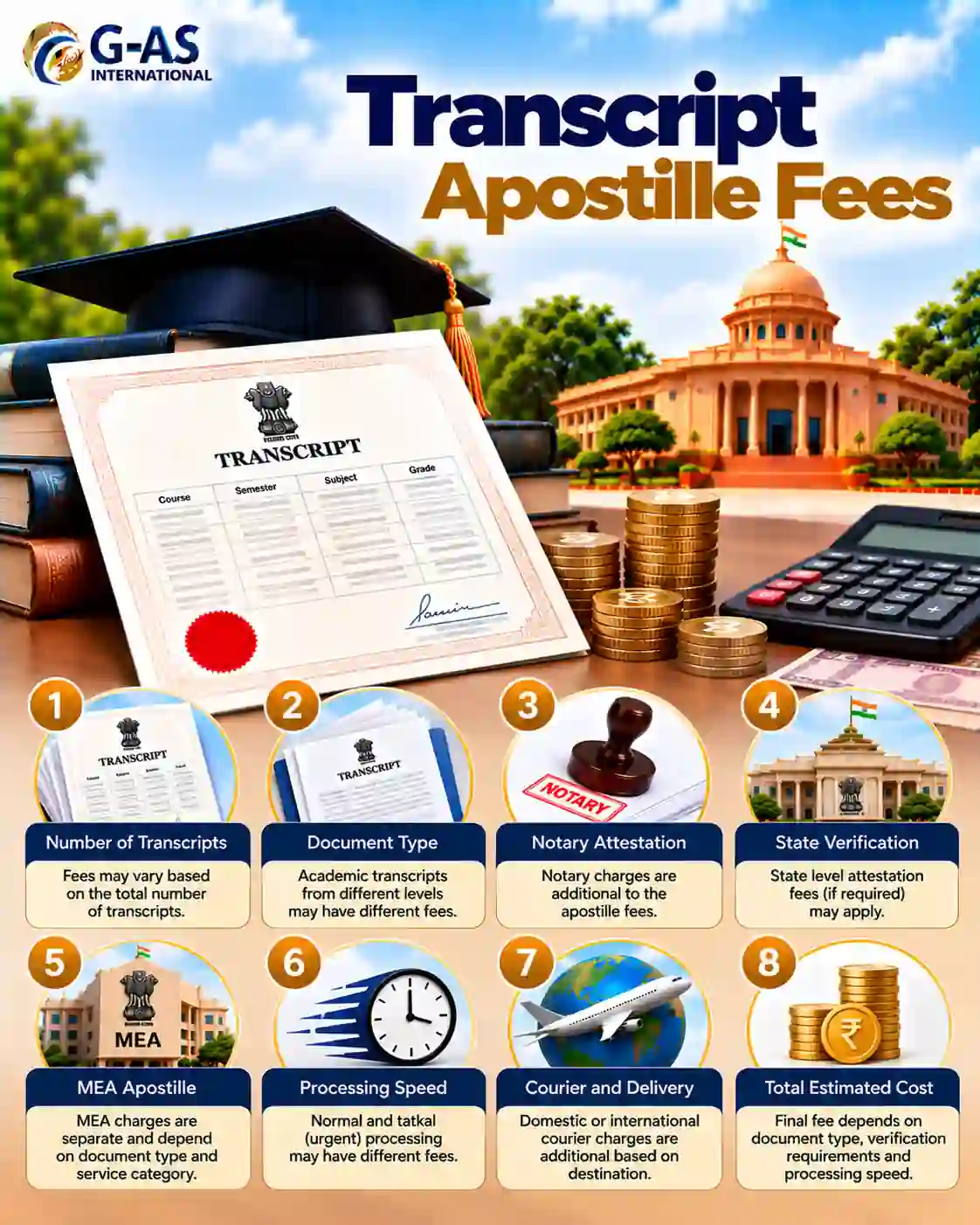
Transfer Certificate Apostille Fees in India depend on more than the basic government apostille charge. The final cost can vary according to the certificate’s authentication route, whether Notary, SDM, HRD, or another pre-authentication step is required, and any document handling or delivery charges involved.
This guide explains the Transfer Certificate Apostille Cost, the charges that may form part of the total price, and why quotations can differ between cases. It will also help you understand the distinction between the official MEA apostille fee and additional expenses connected with verification, processing, and document delivery.
A transfer certificate may need an apostille when it is being submitted abroad as an educational record and the receiving organisation requires formal authentication.
Students changing schools or continuing their education abroad may be asked to provide an authenticated transfer certificate as part of their academic record.
A receiving institution may request the certificate to confirm that the student formally left the previous school or institution before joining a new programme.
Some institutions use school leaving and transfer certificate terminology differently. Where the document is issued as a leaving certificate, review the school leaving certificate procedure before proceeding.
The exact submission requirements can vary according to the issuing institution, authentication route and document format, so the certificate should be reviewed before processing.
Check that the student's name, institution details, certificate information, signatures and seals are clear and consistent with the document being submitted.
Supporting records can depend on the applicable route. Use the detailed document preparation checklist to review what may be needed before dispatch.
Confirm where the certificate will be used and whether the school, university, government office or other receiving organisation specifically requires an apostille.
Resolve obvious spelling differences, unclear seals, damaged areas or missing institutional details before starting the authentication process, particularly when additional verification may be required.
The appropriate route depends on the certificate, its issuing authority and the verification method applicable to that educational record.
First identify who issued the transfer certificate, where it will be submitted and whether an apostille is the correct authentication method for the intended overseas use.
Educational documents can follow different verification paths depending on their issuer and current authentication arrangements. The pre-authentication and authority route guide explains this stage in greater detail.
Where prior verification is applicable, the certificate must complete that stage before proceeding further. The correct sequence should be confirmed rather than assuming every educational certificate follows an identical route.
Once the necessary preliminary checks and authentication are complete, the eligible certificate can proceed through the applicable apostille channel. See the complete step-by-step processing sequence for the wider procedure.
Processing should be planned around the complete document route rather than considering the final apostille stage in isolation.
The overall timeline can depend on whether prior authentication or issuing-authority verification is required and whether the submitted record needs correction. For a dedicated explanation, review the processing timeline guide.
Before starting, confirm which verification stages apply to the specific transfer certificate and whether additional document preparation or authority checks are necessary. This helps distinguish the required procedure from optional handling arrangements.
Many avoidable problems begin before final submission, particularly when document details or the applicable verification route have not been checked carefully.
Using a route that does not match the certificate's issuing authority can lead to additional verification or require the submission to be corrected.
Unclear signatures, institutional details, seals or certificate information can make verification more difficult and may require clarification from the relevant issuing authority.
Differences between the certificate and supporting records should be reviewed before submission so that significant discrepancies can be addressed at the appropriate stage.
Incomplete preparation or unresolved document issues can interrupt processing. Review the common rejection and correction issues before submitting the certificate.
Complete these basic checks before beginning the process to reduce avoidable questions or document handling problems.
These answers cover practical questions that commonly arise before a transfer certificate is submitted for apostille.
No. The appropriate procedure can vary according to the issuing authority, document format and applicable verification route, so the certificate should be reviewed before submission.
Yes. Confirm the destination country and the organisation receiving the certificate so you know whether an apostille is required for that particular overseas use.
It can. Unclear, damaged or altered-looking document details may require additional checking, particularly when the issuing authority, signature or seal cannot be readily verified.
The terminology can overlap, but the title and purpose depend on the issuing institution. Use the exact document issued and confirm how the receiving organisation describes the required record.
Confirming the route helps determine what must happen before final apostille processing and reduces the risk of sending an educational document through an unsuitable authentication path.
Your Trust, Our Responsibility — That’s a G-AS Commitment.
Get Document Guidance